User guide and library capabilities
The three modules PlasmaNet.nnet, PlasmaNet.cfdsolver and PlasmaNet.poissonsolver
each have a corresponding folder in the root of the directory where these libraries are
used for studies. Simple example runs are given for each functionality.
CfdSolver/
Running the studied fluid simulations of plasma oscillation and double headed streamer.
euler/covo
Convective vortex case for validating the Euler equations Lax-Wendroff scheme. The isentropic vortex solution can be launched using
euler -c covo.yml
euler/poscill
Plasma oscillation test case described in [Cheng] and ran by the following command
plasma_euler -c 101.yml
scalar/transport
Scalar advection and diffusion are validated on a simple square geometry for a scalar variable \(u\) that follows
A robust upwind scheme for advection and a central difference scheme for diffusion are implemented for now. Geometry parameters as well as values of constant velocity and diffusion coefficient can be tuned in the scalar.yml. The associated executable created by the library is scalar so that a simple simulation can be launched by running
scalar -c scalar.yml
scalar/dh_streamer
Double headed streamer simulation that can be run using
streamer -c dh_streamer.yml
NNet/
This repository allows to train neural networks from configuration files and post-process the training (plotting things such as metrics and losses). Two main architectures are studied in PlasmaNet: UNet and MSNet architectures. Sketches are showcased below:

Sketch of UNet
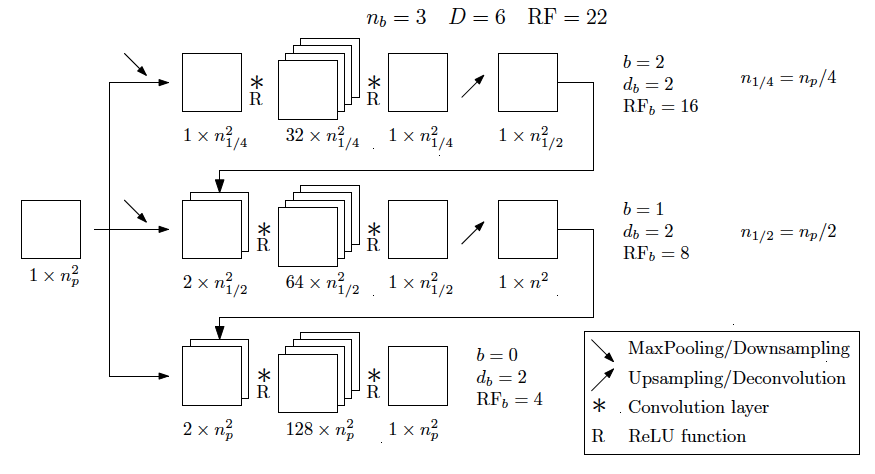
Sketch of MSNet
Training can be launched by running
train_network -c train.yml
More details on the implementation of the configuration file are found in the developers guide.
PoissonSolver/
This repository contains four directories:
analytical/
Study of the exact solution of the 2D cartesian Dirichlet Poisson problem. The solution relies on the exact Green funtion that is expanded in [Jackson].
datasets/
Generation of datasets for the deep neural networks. The main datasets are random and fourier datasets explained in the article. Task-based parallelization using the multiprocessing is done to speed up the datasets generation. A typical random can be generated by running
python rhs_random.py -c train.yml -nr 8 -nn 101
linsystem/
Different profiles of right hand side and boundary conditions are considered in this repository and their solutions from linear system solvers are plotted.
network/
Neural networks are evaluated in this repository. They can be evaluated either on datasets or on specific profiles like the ones presented in linsystem/.
perfs/
Performance of the different options for solving the Poisson equation is monitored in this repository.
tests/
Unit tests of Poisson resolution.